 Base
Base Unichain
 Robinhood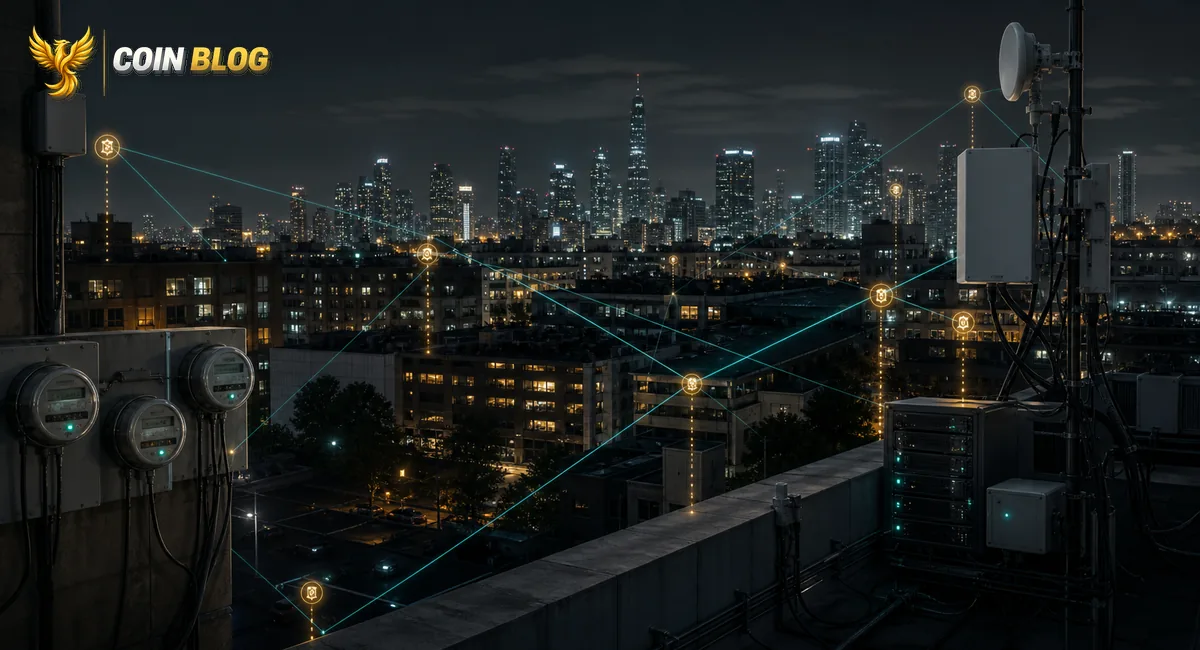
DePIN: Why Building Physical Infrastructure Is Hard
One of the most ambitious ideas in crypto is that you can bootstrap real, physical infrastructure the same way you bootstrap a software network: with tokens. The category has a name, decentralized physical infrastructure networks, usually shortened to DePIN, and the vision behind it is genuinely bold. Instead of a giant company spending billions to build wireless coverage, storage, mapping data, or energy grids, you let thousands of ordinary people supply the hardware, reward them with tokens, and let a protocol coordinate the whole thing. If it works, it is a way to build the physical world with the economics of open networks. The reason DePIN is so interesting is also the reason it is so hard: software is easy to copy and coordinate, and the physical world is neither.
The core mechanism is elegant on paper. A network needs supply, so it issues tokens to whoever provides that supply early, when there is little or no demand yet. Those early contributors are betting that the network will grow and the tokens will become valuable. As real demand arrives, revenue starts to justify the rewards, and eventually the network is supposed to stand on its own economic feet. It is a clever way to solve the classic chicken-and-egg problem of infrastructure, where no one wants to build capacity before there are customers and no customers arrive before there is capacity. Tokens pay for the capacity up front and let demand catch up later.
The subsidy phase everyone underestimates
The first hard truth about DePIN is that the early token rewards are, in plain terms, a subsidy. In the beginning, contributors are not being paid by real users; they are being paid by the promise of future value baked into the token. This is not inherently bad. Every network has to solve the cold-start problem somehow, and paying suppliers with equity-like tokens is a legitimate way to do it. But it creates a dangerous illusion. A network can look thriving during the subsidy phase, with impressive maps of coverage and lots of active hardware, while almost none of that activity is driven by genuine paying demand.
The test that matters is what happens when the subsidy shrinks. Token emissions cannot stay high forever, because endless inflation destroys the value of the reward it is trying to provide. As emissions taper, contributors who joined purely to farm tokens have no reason to stay unless real revenue has arrived to replace the subsidy. If it has not, supply collapses, coverage degrades, and the network can enter a downward spiral where falling participation makes the token worth less, which drives away more participants. Many DePIN projects have discovered that building supply is the easy part and building durable demand is the part that actually decides survival.
Coordinating atoms is nothing like coordinating bits
The second hard truth is physical. Software networks scale almost for free because copying data costs nothing and a good protocol can coordinate millions of nodes with pure logic. Physical infrastructure does not behave that way. Hardware breaks, needs power, occupies real locations, and depends on people to install and maintain it correctly. A wireless network is only useful where the coverage actually is, not where a map says it should be, and a storage network is only useful if the data is genuinely retrievable when someone needs it, not merely claimed to exist.
This is why proof becomes the central engineering challenge of DePIN. The protocol has to verify, without trusting anyone, that a contributor is really providing the service they are being paid for. A wireless project like the one documented at Helium has to prove that coverage exists at a specific place and time, and to defend against people who fake coverage to earn rewards without doing the work. A storage network like Filecoin has to continuously prove that data is still being stored intact, not deleted the moment the reward was claimed. These proofs are difficult, adversarial, and expensive to get right, because any gap between what the protocol can verify and what is actually happening becomes an opportunity to game the system. Much of the real innovation in DePIN is not the token model at all; it is the cryptographic and economic machinery that keeps physical claims honest.
Where DePIN genuinely makes sense
Given all this difficulty, it is fair to ask where DePIN is actually the right tool rather than a token wrapper on an ordinary business. The honest answer is that it shines in specific conditions. It works best where the required hardware is cheap enough for ordinary people to own, where geographic distribution is itself a feature rather than a cost, and where a centralized incumbent would be slow, expensive, or unwilling to serve the market. In those situations, letting a crowd supply the infrastructure can genuinely beat the traditional model, because the crowd already owns the locations, the rooftops, or the spare capacity that a company would have to acquire at enormous cost.
DePIN struggles in the opposite conditions. Where infrastructure demands heavy capital, tight reliability guarantees, deep expertise, or strict regulatory compliance, the messy incentives of a token crowd tend to work against the quality the service needs. Nobody wants their emergency communications or their critical data resting on hardware maintained by anonymous participants chasing a token price. The most credible DePIN projects understand this and aim at markets where distribution and openness are strengths, not liabilities.
The real test is boring, and that is the point
Stripped of the hype, DePIN is not magic and it is not a scam; it is a financing and coordination mechanism with a specific, narrow set of conditions where it outperforms. The exciting phase, when tokens rain down and coverage maps light up, is the easy phase. The real test comes later and it is deliberately boring: does the network generate enough genuine, recurring revenue from real users to sustain itself once the subsidy fades? Can it prove, cheaply and reliably, that the physical service is actually being delivered? Can it retain contributors on the strength of real economics rather than speculation?
A DePIN network that can answer yes has done something remarkable, using open incentives to build a piece of the physical world that a single company might never have built. A network that cannot is simply paying people to hold hardware until the music stops. The technology is real, the model is legitimate, and the difficulty is exactly where the honesty lives. Building physical infrastructure is hard, and no token can change that; it can only decide who pays for it and when.