 Base
Base Unichain
 Robinhood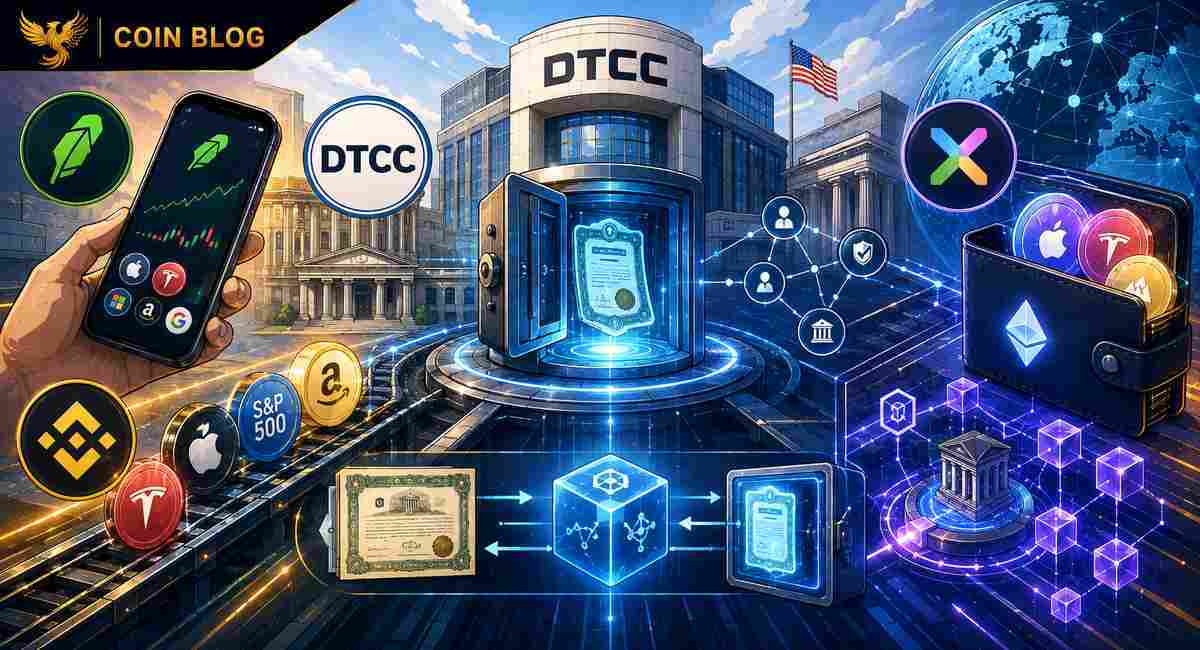
Tokenized stocks are often presented as one simple idea: put shares on a blockchain and make them easier to trade. The market now developing around them is much more complicated. Products that look similar on a screen can provide very different ownership rights, custody arrangements and routes to recovery.
DTCC pushed this issue into a new stage on July 15, 2026. The company said assets held at The Depository Trust Company were converted into tokens and used in real production trades. More than 30 firms from traditional finance and the digital asset industry participated, and the event included equity and Treasury conversions, delivery-versus-payment transactions and collateral movements.
The milestone matters because DTCC is not a startup trying to recreate the stock market from outside. Its subsidiaries sit inside the existing post-trade system. DTC holds securities for market participants, while DTCC provides clearing, settlement and other infrastructure used across U.S. markets. When this system tokenizes an asset, the goal is not merely to create a blockchain instrument that follows a share price. The goal is to let an existing security move between traditional and tokenized forms without losing the legal and operational framework around it.
That approach is arriving at the same time as crypto platforms expand their own stock-linked products. Robinhood offers more than 2,000 Classic Stock Tokens to eligible European customers. Binance is listing bStocks linked to individual companies and exchange-traded funds. xStocks can be transferred to self-custodial wallets and used across supported blockchain applications.
All of these products can be described as tokenized equities. They are not the same financial object.
One label, several legal realities
The most important fact about a stock token is not the blockchain on which it appears. It is the legal claim represented by the token.
Robinhood states that its Classic Stock Tokens are derivative contracts between the customer and Robinhood. They reflect the price of an underlying stock or exchange-traded product, but they do not grant rights to that underlying security. Robinhood owns the underlying assets and holds them through a licensed U.S. custodian. Eligible token holders may receive a corresponding cash amount when the underlying asset pays a dividend, but this is not a dividend in the ordinary shareholder sense because the customer does not own the share.
Binance describes bStocks differently. According to its product disclosures, bStocks are certificates representing certain financial instruments. They represent an interest in underlying securities held by the issuer, BTech Holdings, but they are not direct ownership of the underlying shares. That distinction matters in questions involving voting, corporate actions, insolvency and claims against the issuer or custodian.
xStocks uses another structure. Its documentation says each token is collateralized 1:1 by the corresponding stock or exchange-traded fund held with a regulated custodian. The tokens are designed to move across wallets and supported networks, and holders can use them in decentralized finance applications. This gives the product greater portability than a stock-linked balance that remains inside one platform.
Portability does not remove the legal chain. A holder still depends on the issuer, custodian, redemption process and contractual structure connecting the token to the underlying security. A token can move permissionlessly between wallets while the asset behind it remains inside a regulated custody system.
The U.S. Securities and Exchange Commission has already recognized that tokenized securities can take different forms. Its January 2026 statement distinguishes, among other structures, between custodial tokenized securities and synthetic tokenized securities. In a custodial model, a third party holds the underlying security and issues a crypto asset representing a direct or indirect ownership interest or entitlement. In a synthetic model, the instrument may provide economic exposure without conveying an ownership interest in the underlying asset.
This is why the phrase "backed by shares" is not enough. Investors need to know what kind of claim exists, who records it and what happens when the system is under stress.
Why DTCC changes the argument
The DTCC model begins from a different point. Instead of issuing a new retail product linked to a share, DTC converts an asset already held in its custody into a tokenized representation, sometimes described as a digital twin. The security can move between its traditional form and its tokenized form.
DTCC says the tokenized version will carry the same legal and economic rights, investor protections and ownership rights as the asset in traditional form. It also says the traditional and tokenized versions will share the same CUSIP, which is intended to connect both forms to a common liquidity pool rather than divide them into separate instruments.
This difference changes the purpose of tokenization. In the crypto platform model, the first question is usually distribution: can more users access the price exposure, trade fractions, move the token to a wallet or use it in decentralized finance?
In the DTCC model, the first question is market infrastructure: can a security that already sits inside the regulated system move across approved blockchain networks, participant wallets and settlement workflows without breaking corporate actions, ownership records or compliance controls?
The July production event showed the direction. Participants converted equities, exchange-traded funds and U.S. Treasuries, completed delivery-versus-payment transactions and moved collateral. These are not consumer interface features. They are post-trade functions that determine whether assets can settle, secure obligations and move efficiently between institutions.
DTCC plans to launch its Tokenization Service in October 2026. The service is authorized under a time-limited SEC no-action framework for a defined set of highly liquid assets, including Russell 1000 constituents, major index exchange-traded funds and U.S. Treasury securities.
The system is not designed to be fully permissionless. Participant wallets and blockchain networks must be approved. DTCC also describes controls including minting, burning, forced transfers, clawbacks, pauses and freezes. Crypto users may view some of these functions as centralization. Regulated institutions view them as necessary tools for compliance, recovery and legal enforcement.
The result is a market in which openness and institutional certainty are being optimized differently.
Access, ownership and liquidity are not the same thing
Retail tokenized products solve a real problem. Many investors cannot easily open an international brokerage account, fund it in dollars or trade fractional U.S. securities. A crypto application can reduce the number of steps and provide a familiar funding route through stablecoins.
Extended trading hours can also be useful. A user may be able to trade a stock-linked token while the traditional market is closed. A transferable token can be held in a personal wallet, moved between platforms or used as collateral.
But each benefit creates a corresponding question.
Trading outside the underlying market's hours does not mean the underlying share has continuous price discovery. When the reference market is closed, liquidity can become thinner, spreads can widen and prices can diverge from the next traditional market opening. A token may trade 24/7 while creation and redemption remain limited to weekday market hours.
Fractional access does not answer the ownership question. A small position in a derivative or certificate may provide useful economic exposure, but it is not automatically equivalent to a fractional registered share.
Self-custody removes one layer of platform custody but does not remove issuer or reserve risk. A user can control the private key to a token while still depending on another entity to hold the underlying securities and honor redemption.
Onchain composability introduces another trade-off. A tokenized stock can become collateral in a lending market or an asset in a liquidity pool. That creates new uses, but it also connects equity exposure to smart contract, oracle and liquidation risk. If the underlying stock market is closed while the token is used in a continuously operating lending protocol, the system needs a reliable method for pricing sudden news and handling gaps when the reference market reopens.
DTCC's model may reduce some legal uncertainty because the tokenized form is tied directly to existing securities infrastructure. It does not automatically deliver global retail access, permissionless transfer or open decentralized finance integration. Approved wallets, network controls and participant requirements can limit who uses the system and how freely assets move.
Tokenization therefore does not produce one universal upgrade. It creates a menu of trade-offs between access, control, legal continuity and programmability.
Who gains, and where the risk moves
Crypto platforms benefit because stock-linked products can turn a crypto trading account into a broader financial application. Users can move between stablecoins, digital assets and equity exposure without opening a separate brokerage relationship. This can increase retention and trading activity.
Issuers and custodians benefit because every transferable token needs a reliable connection to the underlying asset. The more tokenized equities spread across chains, the more important custody, reconciliation, corporate action processing and redemption become.
Wallet providers and blockchain networks also gain. If securities can move into personal wallets, those wallets become financial accounts containing cash-like tokens, crypto assets, bonds and equities. Networks compete not only for transaction volume but for the financial applications built around those assets.
Traditional infrastructure providers can benefit rather than disappear. DTCC's strategy shows how an incumbent can place blockchain rails beneath existing market functions while preserving its role in custody, settlement and risk management. Tokenization may compress some intermediaries, but it can strengthen the institutions that control authoritative ownership records and access to deep liquidity.
The greatest risk falls on users who assume that identical price exposure means identical legal protection. In normal markets, differences between a derivative, a certificate, a custodial entitlement and a tokenized share may seem abstract. They become concrete during insolvency, a disputed corporate action, a trading suspension or a failed redemption.
Platform disclosures are therefore part of the product, not a legal appendix. Investors need clear answers to basic questions. Do they own the underlying share? Can they vote? How are dividends handled? Can they redeem the token for the underlying asset or only for cash? Who holds the security? Is the holder protected if the issuer or custodian fails? Can the token be frozen or clawed back? Which country's law governs the claim?
Decentralized finance protocols face a related risk. Accepting a tokenized stock as collateral requires more than reading an onchain price. The protocol must understand trading hours, redemption capacity, issuer concentration, jurisdiction and the possibility that transfers could be paused by a regulated operator.
What the next phase will test
The next phase will not be decided by the number of stock tickers placed onchain. It will be decided by whether tokenized equities can preserve reliable rights while improving how assets move.
DTCC's October launch will be a major test. The important metrics will include which institutions use the service repeatedly, which networks are approved, how quickly assets convert between forms and whether tokenized collateral can move across trading, clearing and treasury workflows without creating fragmented liquidity.
Retail products need a different test. Trading volume matters, but redemption volume, wallet withdrawals, spread quality and disclosure quality matter more. A token can generate high turnover without becoming a durable financial instrument.
Regulators will also have to prevent naming from outrunning substance. A product called a tokenized stock may be a security entitlement, a certificate, a derivative or a synthetic contract. Clear taxonomy can support innovation because platforms will compete on defined features rather than ambiguous labels.
There is also a plausible counterargument to the institutional path. Preserving every existing control can limit the benefits of blockchain. If tokenized securities can move only between approved wallets on approved networks, the system may become a faster version of the current market rather than an open financial layer. Crypto-native products may innovate more quickly because they accept greater structural risk.
The opposite counterargument applies to the retail crypto path. Open transfer and rapid product launches are valuable only if the legal claim remains reliable. A composable token with unclear ownership or weak redemption can spread risk faster than it spreads access.
The most durable model may combine elements of both. It could preserve recognized ownership rights and corporate actions while allowing controlled movement across interoperable networks and applications. That would be less open than a permissionless token and more flexible than a traditional brokerage ledger.
Conclusion
Tokenized stocks are not moving toward one market. They are splitting into products designed for different purposes.
Crypto platforms are building distribution systems that make equity exposure easier to access, fund and move. DTCC is building an infrastructure system that allows existing securities to enter tokenized workflows without leaving the legal and operational framework of traditional markets.
Neither model wins simply by using a blockchain.
The retail model must prove that convenience does not hide weaker rights, concentrated issuer risk or fragile redemption. The institutional model must prove that legal continuity and compliance controls can coexist with meaningful improvements in settlement, collateral mobility and interoperability.
For readers, the practical rule is simple: never evaluate a tokenized stock by its ticker or price chart alone. Ask what the token represents, who holds the underlying security, which rights are preserved and how the claim can be enforced.
The next tokenization race will not be won by the platform with the longest asset list. It will be won by the system that connects access, ownership, liquidity and settlement without making users choose between convenience and legal certainty.
Primary sources
- DTCC: DTCC Turns Tokenization into Reality, July 15, 2026
- DTCC: Live Production Trades
- DTCC: Development of the DTC Tokenization Service
- DTCC: Tokenization Service overview
- SEC: Statement on Tokenized Securities, January 2026
- Robinhood EU: Classic Stock Tokens
- Binance: bStocks product and ownership disclosure
- xStocks documentation
- DTCC: SEC no-action framework for DTC-custodied tokenized assets