 Base
Base Unichain
 Robinhood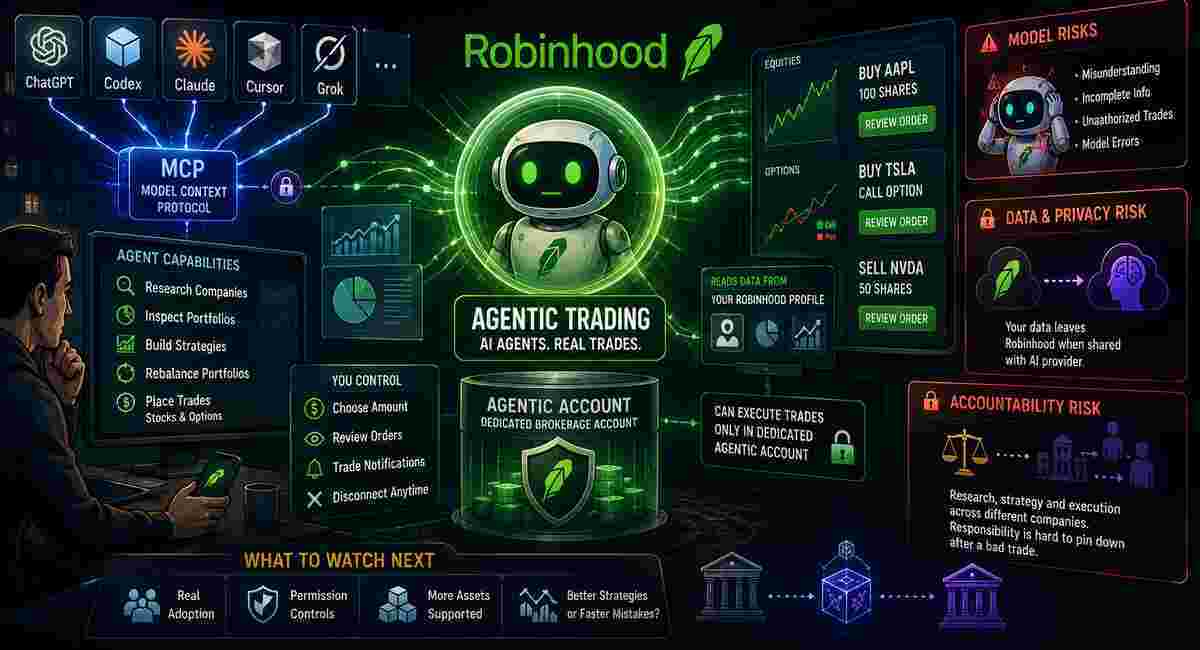
Robinhood has made Agentic Trading available through its Model Context Protocol server, allowing users to connect third-party AI agents to a dedicated brokerage account. Compatible platforms include ChatGPT, Codex, Claude, Cursor, Grok and other services that support MCP.
The agent can research companies, inspect portfolios, build or rebalance strategies and place long equity and options orders. Users decide how much money to transfer into the separate Agentic Account, can review proposed orders, receive trade notifications and disconnect the agent at any time. The agent can read data from the user's wider Robinhood profile, but it can only execute trades inside the dedicated account.
The larger shift is from AI-generated investment commentary to direct financial execution. Robinhood is effectively turning brokerage access into infrastructure that outside agents can use. This could push brokers to compete through agent connectivity, controls and data access instead of relying only on their own apps.
The separation of funds limits the amount directly exposed to an agent, but it does not remove model risk. An agent may misunderstand instructions, rely on incomplete information or submit trades without confirmation when the user has allowed autonomous execution. Financial data also leaves Robinhood's environment once it is shared with the selected AI provider.
The second-order risk is accountability. When research, portfolio construction and execution happen through different companies, responsibility becomes harder to separate after a bad trade. Next, watch real adoption, the quality of permission controls, support for additional assets and whether agent-driven trading creates repeatable strategies or simply faster mistakes.