 Base
Base Unichain
 Robinhood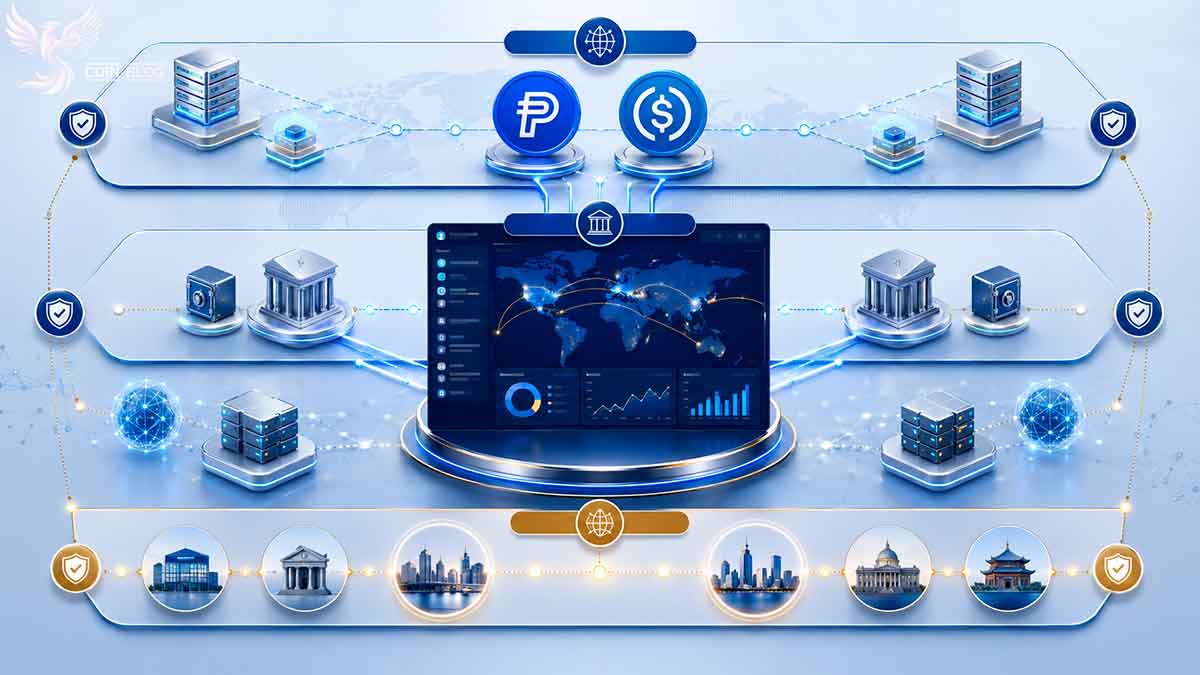
Stablecoins were long explained through exchanges, trading and DeFi. Now the main shift is happening somewhere else: companies and payment networks are testing whether digital dollars can become a working
layer for settlements, treasury and cross-border settlement.
From token to payment route
The story of PayPal USD on Polygon shows this shift clearly. PYUSD is now issued natively on Polygon Chain through Paxos and is available through Polygon Open Money Stack. Launching on one more network would not be a major story by itself. What matters more is the package being built around the token for business payments: wallets, fiat access, compliance tools, routing and settlement.
For a company, blockchain is not a product on its own. A company needs a clear route for money: from a customer or partner to treasury records, and then, if needed, back into local currency.
That is why PYUSD in this setup looks not only like a crypto asset, but like a payment component inside a longer operational process. It is not enough for a company to know that a token can be transferred quickly. It needs to know who issues it, whether redemption exists, how transaction checks work, what happens with mistaken payments, how the finance team reconciles fund movement and whether the same process can work across borders.
Paxos describes PYUSD as PayPal's stablecoin for payments, backed 1:1 by the U.S. dollar and issued by Paxos Trust Company. Polygon adds a second layer to this: distribution and payment infrastructure.
Why Hyundai's corporate test matters more than its size
Hyundai Card's proof of concept gives a more practical example. According to Hyundai Card Newsroom, Hyundai Motor America converted $20,000 into USDT, sent the amount to Hyundai Motor Mexico, and then the funds were converted back into U.S. dollars. The whole transfer and verification process took around seven minutes on average.
The amount was small, so this case should not be presented as proof of mass production usage.
The signal is different: Hyundai Card says that, together with Hyundai Motor, it reviewed accounting, tax, legal and internal control issues before designing the process. This is exactly the layer where corporate adoption usually becomes difficult. Technology can reduce transfer time, but it does not remove operational requirements.
The treasury team must understand how to record such an operation. Lawyers need to see which entity sends and receives value.
The compliance team must know which monitoring and reporting rules apply.
The finance team must understand how the conversion rate is recorded and which documents confirm the movement. Stablecoin settlement moves a familiar banking process into a new environment, rather than removing the process itself.
Two models for one payment problem
That is why the stablecoin story is no longer just about public blockchain adoption. It is a competition between full payment stacks. One route is the public stablecoin route, where Paxos, Circle and other issuers create regulated dollar tokens, while networks and service providers build tooling around them.
The other route is the bank-led route, where banks use tokenized deposits or shared ledgers to upgrade payment flows without fully moving to public stablecoin rails.
Swift's new blockchain-based ledger belongs to the second route. Swift says that 17 banks from six continents are preparing to test live transactions using tokenized deposits for 24/7 cross-border payments and more efficient liquidity. The shared ledger is designed to work as an orchestration layer for bank-issued tokenized deposits, while final settlement remains connected to existing systems.
This is not the same approach as PYUSD on Polygon. It is a different answer to the same business problem: companies need faster and more flexible cross-border payments that depend less on time zones, banking windows and chains of intermediaries.
Public stablecoins can enter fintech apps, marketplaces, contractor payouts and regions with weaker dollar access more quickly. Bank tokenized deposits may be more convenient for large corporate clients
that already depend on banking relationships, credit controls and internal approval systems. Both models try to fix the same weakness of traditional cross-border payments: money often moves through banking hours, correspondent chains and fragmented local processes.
Regulated infrastructure becomes part of the product
The OCC approval for Circle adds another layer to this picture. Circle said it received approval from the Office of the Comptroller of the Currency to establish First National Digital Currency Bank, N.A., which will operate as Circle National Trust. The company describes it as a national trust bank for fiduciary digital asset custody, while reserve management is listed as a future capability.
This does not turn Circle into a regular commercial bank with deposits and lending. But it does show where the market is moving: stablecoin infrastructure is shifting toward regulated custody, reserve oversight and institutional standards.
For enterprise users, the technical functionality of a token is no longer enough. They need to explain the payment system to auditors, banking partners, the board of directors and regulators. A stablecoin with liquidity but weak governance is difficult to use in serious payment flows. A stablecoin with strong compliance but weak distribution may also fail to become useful.
The market is moving toward a combined test: trusted issuance, clear custody, usable APIs, local fiat access and reliable settlement must work inside one operational setup.
The CBDC provision in H.R. 6644 adds the political background. The bill text says that the Board of Governors of the Federal Reserve System or a Federal Reserve bank may not issue or create a central bank digital currency, or a digital asset substantially similar to a CBDC, directly or indirectly through a financial institution or another intermediary.
The provision is set to expire on December 31, 2030. The House Financial Services Committee also separately stated that the law includes a prohibition on the issuance of a CBDC until that date.
This does not mean that a retail CBDC in the United States was close to launch. But it does mean that private digital dollar infrastructure has more room while a direct retail digital dollar from the Fed remains politically restricted.
The main risk is operational dependency
For stablecoin companies, this window is useful, but it does not remove the risks. If private digital dollars become more important for payments, they become more visible to regulators and policymakers.
Stablecoin issuers may face higher requirements for reserves, redemption, operational resilience, sanctions screening and consumer protection. Payment apps may have to prove that stablecoin flows do not bypass local rules.
The second effect is concentration. If companies use a bundled payment stack for fiat access, compliance, routing, custody and settlement, a failure at one provider can affect the whole flow.
The risk may not come from the blockchain. It may come from an off-ramp outage, a compliance block, a liquidity shortage, an account freeze at the issuer, a wallet provider issue or a reporting error.
The next stage should be measured by usage, not announcements. PYUSD volume on Polygon matters, but merchant settlement and payout activity matter more. Hyundai's European PoC matters if it shows a repeatable process, not a single controlled test. Swift's pilots matter if tokenized deposits can move from pilot rails into real corporate treasury workflows. Circle National Trust matters, but the market will watch how custody and reserve management develop in practice.
The main conclusion is simple: stablecoins are becoming part of payment infrastructure because they sit at the intersection of software, dollars and settlement. But the winner will not be the token with the loudest launch. The winner will be the stack that can move value from fiat entry to on-chain or tokenized settlement, and then back into usable money, while keeping compliance, custody and reporting clear enough for real companies.